For Facilitators and Coaches
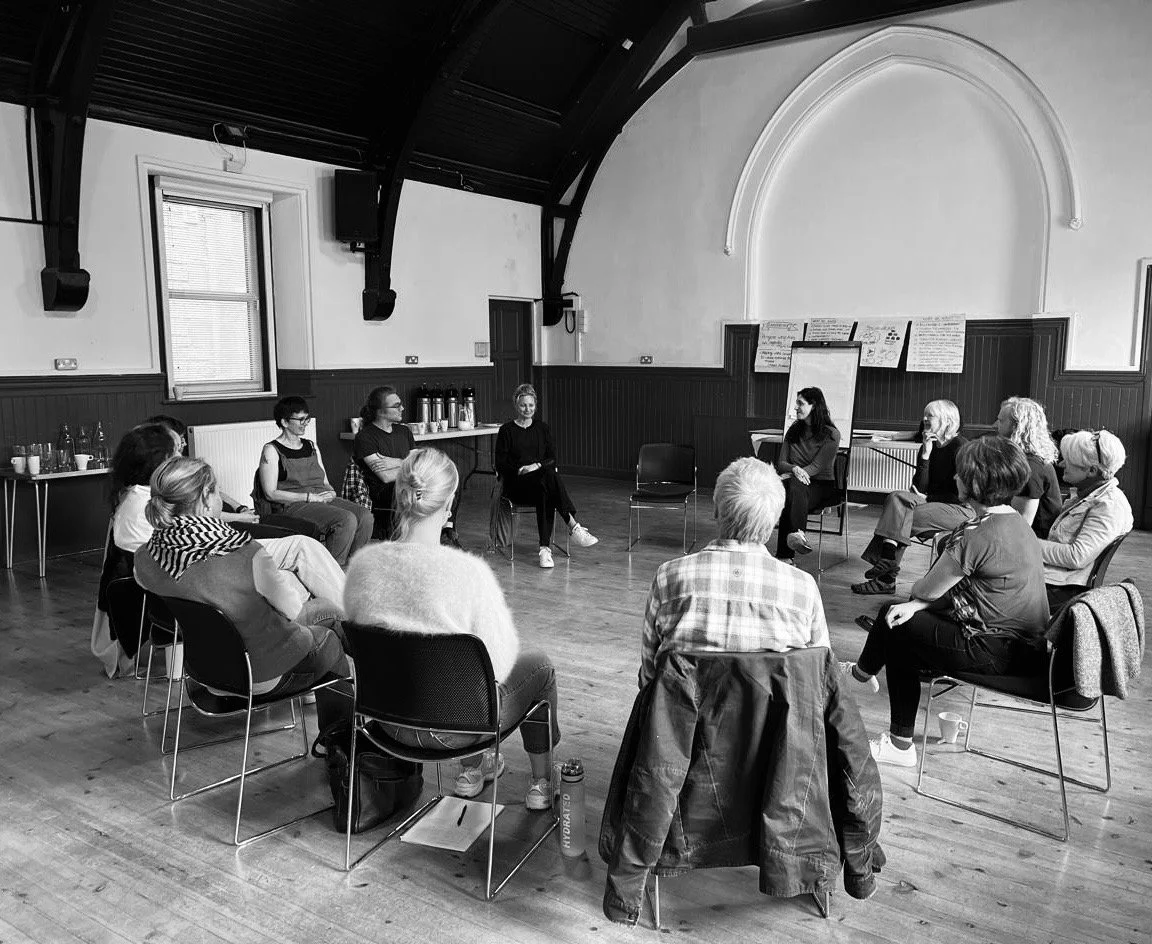
Go beyond consensus seeking and enable conversations where people can say what needs to be said.
As a practitioner, you know how to hold a group, design a process, and create conditions for powerful conversations and decisions. And yet, you might feel apprehensive of leaning into more complex or challenging dynamics that may emerge in your work.
Many facilitation trainings offer great ways of working with groups, but do not incorporate how to deal with unsaid dynamics or inherent differences and tensions that are present in any group process.
Deep Democracy Foundations training offers a practical, powerful shift in mindset along with nuanced skills for reading and navigating group dynamics, and releasing potential within teams through the power of difference. It will change how you show up as a practitioner, not just what you do with groups.
What makes it different as a practitioner training is that you learn it the same way you will use it - live, on real material, in real time.
The training is not structured around pre-set scenarios. The group brings live questions and surfaces real dynamics to practice on. You will leave with direct experience of the tools working, not just a theoretical understanding of them. You can read more about what a facilitator training is like here.
.Join the next open programme here, or read on for more about what you will learn…
“Very special and unusual”
“My biggest weakness as a facilitator is not feeling confident enough managing conflict. I’d done a different one-day training hoping to address that and really didn’t take anything from it. In contrast, I came out of LDD thinking: I now have a new way of seeing group dynamics and a concrete tool for managing tension, disharmony and conflict, and that very concretely boosts my confidence as a facilitator.
The strength of the trainers made the course stand out, including the ability to answer deep questions, the pace and clarity of explaining concepts, and the overall mastery of the method. A particularly extraordinary part as a participant was the relationship between the two trainers (Francesca and Payam). There were moments where they paused and had a discussion between themselves about how they were reading what was going on in the room and what decision they were going to make next. I felt like I learned as much from observing those discussions (the way they read the room and made decisions) as I did from anything else. It felt very special and unusual, to be allowed to see even a small part of that internal dialogue.
Another standout was how the training was held. It was much less structured than other trainings. The order of content was decided by the group, using the tools in real time. That emergent structure really held my interest. It made our use of tools feel more real than it would have in a highly structured environment because it brought up uncertainty and friction and that uncertainty is what made the examples of using the tools feel rich rather than flat.”
Katharine Segal, Coach, Facilitator, Strategist
What you will learn
Understanding Group Dynamics
Read the dynamics of a group, pick up on the early signs of resistance and emerging conflict and act in a timely manner to reduce tension.
Understand the obstacles to good communication, learn to listen and pay attention to different viewpoints.
Observe group dynamics that exist beyond individuals and manage them for more effective collaboration.
Begin and end meetings with a powerful way to connect the group and get a handle on what is happening in the room.
Collaborative Decision Making
Facilitate dynamic conversations which unleash engagement and creativity.
Harness the power of collective intelligence by enabling the most quiet participants to find their voice and express their views.
Create safety in large or small groups for difficult conversations to take place.
Search for the wisdom of the unpopular views and improve decision- making by incorporating this valuable information.
Resolving Conflict and Tension
Recognise the underlying tensions that block a group's progress, diagnose when group dynamics become polarised and rigid, and know what facilitation tools to use in such situations.
Appropriately address “elephants in the room.”
Resolve differences of opinions, arguments and conflicts instead of allowing anger and blaming to continue. Learn to unleash the creative potential that lies within every conflict.
Use tension as an opportunity for learning and to improve relationships.
Developing inner skills
Grow the capacity to hold all views as valuable, including the uncomfortable, unpopular, or dissenting ones.
Stay present with tension, difficulty, and strong emotion without collapsing into fixing, withdrawing, using rank, or avoiding.
Build self-awareness of your own reactions, edges, and assumptions and the ability to work with them rather than be hooked by them.
Develop the inner steadiness that allows you to facilitate, lead, or contribute as a non-polarising presence in charged situations without losing your ground.
Cultivate genuine compassion for the range of views and experiences in yourself and within a group, including those you disagree with.
The Training is ICF accredited, and upon completion, participants will receive a certificate. You will then be eligible for advanced training in Levels 3 and 4 in the method.
“I’m already using LDD in my coaching”
“Before the training I wondered whether LDD would be 'another interesting model' that I learnt about then put on the shelf. How wrong I was! It's a powerful, accessible and immediately applicable set of practical tools that I'm already using in my coaching. I think because at its heart, LDD is really a reminder to bring our full humanity to groups - an invitation to open our eyes and turn towards what's really going on when working to deepen our relationship with others in service of a common good.”
Duncan Brown, Coach
I want to hear from you.
Tell me about what you do, what your learning edges are, what’s next for your learning. Let’s have an interesting conversation together about deepening our skill and contribution through powerful practice.
“Surfaced important needs and normalises challenges”
“I used (a tool from Lewis Deep Democracy) with two co-founders. Me and my colleague were there to help them assess their "readiness" for a strategy process. It worked super well, they enjoyed debating views, not each other and it surfaced some really important needs which had to be met in order for them to feel ready.
I think (Lewis Deep Democracy) normalises challenges and conflict in decision-making and collaboration, and takes some of the antagonism out by offering processes that surface disagreement in healthy ways, without individualising or targeting specific people.”
Emily Bazalgette, Organisational Designer and Coach